Jesus said something very profound concerning Abraham when He said, “Your father Abraham rejoiced that he would see My day; he saw it and was glad” (John 8:56). When Jesus was speaking about “My day,” was He referring to a single day, or was He speaking about the days of His life—the season, the purpose, and the manifestation for which He had come? This becomes even more interesting when we consider how Scripture describes God's relationship with time. The Bible says in Psalm 90:4, “For a thousand years in Your sight are like yesterday when it passes by, or as a watch in the night,” and Peter says in 2 Peter 3:8, “With the Lord one day is like a thousand years, and a thousand years are like one day.” This tells us that when God looks at time, He does not look at it in exactly the same way that we look at it. We look at time through days, months, years, seasons and generations, but God sees time within the framework of His eternal purpose.
This leaves us with an important question when we consider the prayer Jesus taught His disciples. Jesus said, “Give us this day our daily bread” (Matthew 6:11). Was Jesus simply teaching His disciples to ask God for bread for a single day, or was there a deeper meaning to the phrase “this day”? Could “daily bread” speak not only of the physical bread that sustains you for twenty-four hours, but also of the provision, the favor, the grace, the strength, and the resources that God has ordained for you to have within your day and within the purpose of your life? When we understand that every person is born into a particular time, generation, season and assignment, the language of “this day” begins to take on another dimension.
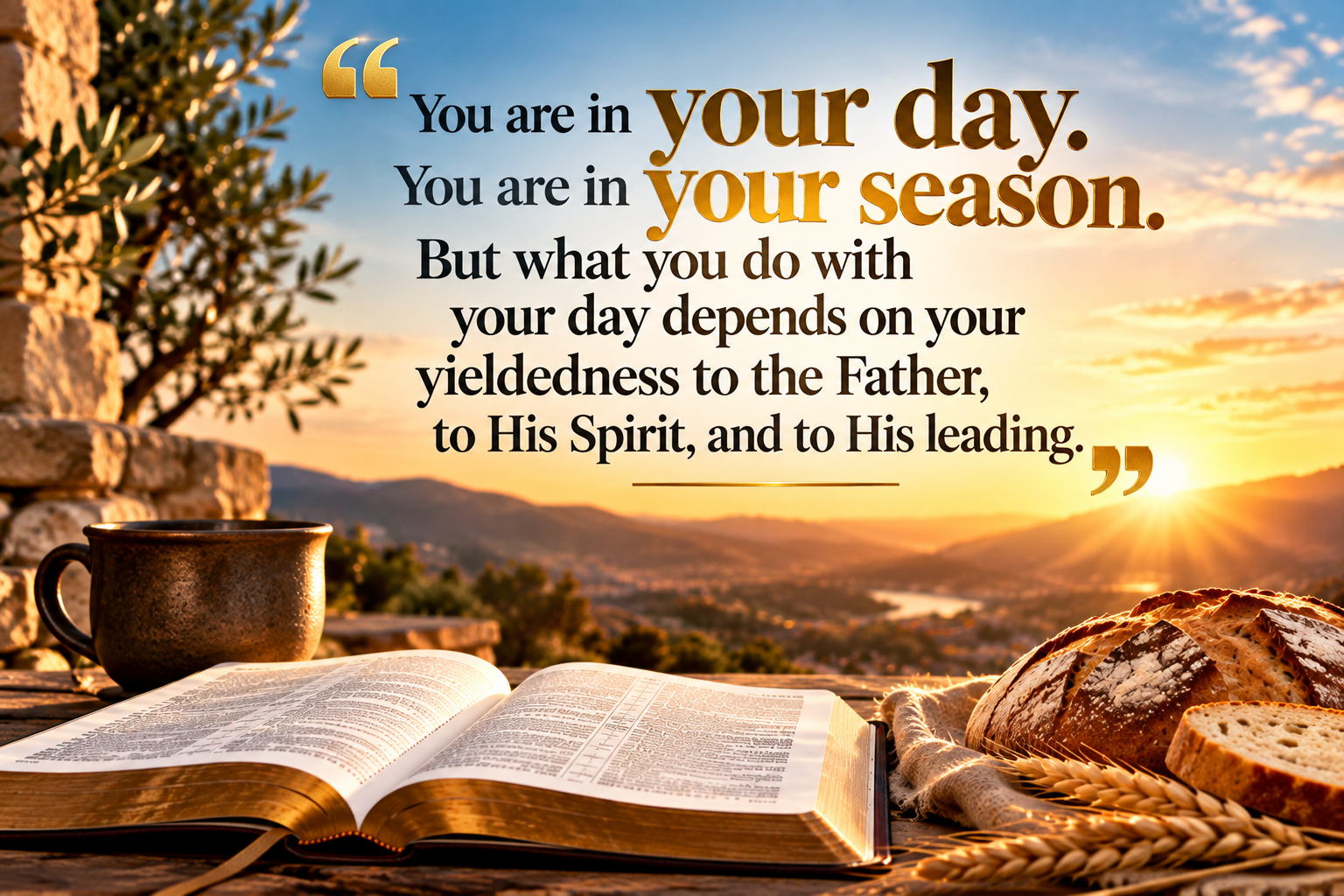
Each and every man, when he is born, is born into his day. You are in your day. You are in your season. There is something that God has ordained for your generation, and there is something that God has ordained for your life within that generation. The Bible says concerning David that “David, after he had served the purpose of God in his own generation, fell asleep” (Acts 13:36). David had a purpose that was connected to his generation. Esther was positioned in her day, and Mordecai said to her, “Who knows whether you have come to the kingdom for such a time as this?” (Esther 4:14). There was a day that Esther had entered into, and there was something that God expected her to accomplish within that day. The same principle applies to us: we are not simply alive in a random period of history. We are living within a day, a season and a purpose that God has allowed us to enter.
But what you do with your day depends on your yieldedness to the Father, to His Spirit, and to His leading. There are many people who have lived their day but did not understand their day. There are people who have been alive in their season but have not understood what their season required from them. Paul is a powerful example of this. Before he became Paul, he was Saul, and he was zealous for the work of God, but he was operating in ignorance. He later testified that he had obtained mercy because he “acted ignorantly in unbelief” (1 Timothy 1:13). Saul was zealous, but his zeal did not mean that he understood the day he was living in. He was persecuting the very people and purpose that God was raising up, believing that he was serving God. This is why the Bible says in Hosea 4:6, “My people are destroyed for lack of knowledge.” You can be in your day and still not understand your day. You can be in your season and still not understand what God is requiring from you in that season.
If you do not know what you are supposed to accomplish in your day, you may not have full access to the provision and to the bread that God ordained for you to have in that day. This means that my provision for today is connected to my understanding of the will and purpose of God for my life. God provides for the vision that He has given you. There is provision connected to assignment. There is grace connected to calling. There is favor connected to purpose. Therefore, when Jesus teaches us to pray, “Give us this day our daily bread,” we are not merely asking God for food to survive another twenty-four hours. We are saying, Father, give us what belongs to this day. Give us what I need for the assignment of this day. Give me the grace for this day, the favor for this day, the strength for this day, the provision for this day, and the wisdom to accomplish what You have ordained for me in this day.
So when you pray, “Give us this day our daily bread,” you are saying, Give us this day victory in our day, give us favor in our day, give us success in our day, give us grace in our day, and give us provision in our day. You are asking God to give you access to what He has already ordained for you within the season in which you are standing. There are things that God has prepared for you, and there are things that God has ordained for you to accomplish. Ephesians 2:10 says that we are “created in Christ Jesus for good works, which God prepared beforehand, that we should walk in them.” If there are works prepared beforehand, then there must also be grace and provision for those works. God does not give you a vision and then leave you without the grace to pursue it. He provides for the vision that He has given you.
But what is also striking is what Jesus says immediately after the request for bread. He says, “And forgive us our debts, as we also have forgiven our debtors” (Matthew 6:12). Why are you asking for forgiveness after you have asked for bread? There is something important here. You are not only praying for the bread; you are praying that nothing will hinder you from having access to, eating, and enjoying the bread that God has given you. You are saying, Father, as I have received my bread, allow me not to be hindered from accessing what You have provided for me. You are asking God to deal with the things within you that can become a hindrance to your walk with Him. You are asking for forgiveness, and you are also being required to forgive those who have debts against you. The issue is not only whether there is bread; the issue is whether you will be able to access and enjoy the bread that God has provided.
This is why Jesus continues the prayer by saying, “And lead us not into temptation, but deliver us from the evil one” (Matthew 6:13). You are not only praying for provision; you are praying for protection and covering. You are asking God to protect you as you walk in your day. You are asking Him to protect the purpose, protect the assignment, protect the provision, and protect you from the things that would interfere with what He has ordained for you. You are saying, Father, as I enter into my day and as I receive the bread for my day, lead me away from the things that would cause me to lose, misuse, or become separated from what You have provided. So the prayer is not simply about receiving bread; it is about having the grace, protection and spiritual condition necessary to access and enjoy what God has provided.
That is why the prayer concludes with, “For Yours is the kingdom and the power and the glory forever” (Matthew 6:13). You are dependent on the power and the glory and the fullness of God to see and enjoy the bread for the day. You can have provision around you and still need God's grace to know how to access it, steward it, and walk in it. You can have a calling and still need the Spirit of God to lead you into the fulfillment of that calling. Everything ultimately comes back to God: the kingdom is His, the power is His, and the glory is His. The bread may be connected to your day, but the One who gives the bread is God.
There is no point in your life where you have withdrawn from the banks of provision that God has set for you. There are dimensions of God's grace, favor, provision and purpose that are connected to the season in which you are standing. Your responsibility is to understand your day and to yield yourself to God so that you can walk in what He has ordained. This is why the prayer, “Give us this day our daily bread,” is so powerful. You are saying, Father, give me what belongs to my day. Give me the provision for my assignment. Give me the grace for my season. Give me the favor for my purpose. Give me the strength to accomplish what You have ordained for me.
The Bible also says, “Beloved, I pray that you may prosper in all things and be in health, just as your soul prospers” (3 John 1:2). It is God's desire for us to prosper. It is God's desire for us to be fruitful. Jesus even said that God “makes His sun rise on the evil and on the good, and sends rain on the just and on the unjust” (Matthew 5:45). God demonstrates His goodness even to those who do not acknowledge Him. This shows us something about the nature of God's provision and His desire for fruitfulness. God desires that you produce fruit. God desires that you become fruitful in the purpose for which He created you. God desires that you have access to what He has ordained for your life.
And so my prayer today is that you will have access to your fruits. I pray that you will have access to your daily bread. I pray that you will understand your day and understand your season. I pray that you will not live your day in ignorance, but that you will understand the will and purpose of God for your life. I pray that you will have access to the favor, the grace and the glory that God has ordained for you. I pray that you will have access to the provision connected to your assignment and the strength necessary to fulfill your purpose. May God give you victory in your day, favor in your day, grace in your day, success in your day and provision in your day. Father, give us this day our daily bread. Give us access to what You have ordained for us in this season, and give us the wisdom and grace to eat, enjoy, steward and fulfill everything that You have placed before us. Amen.