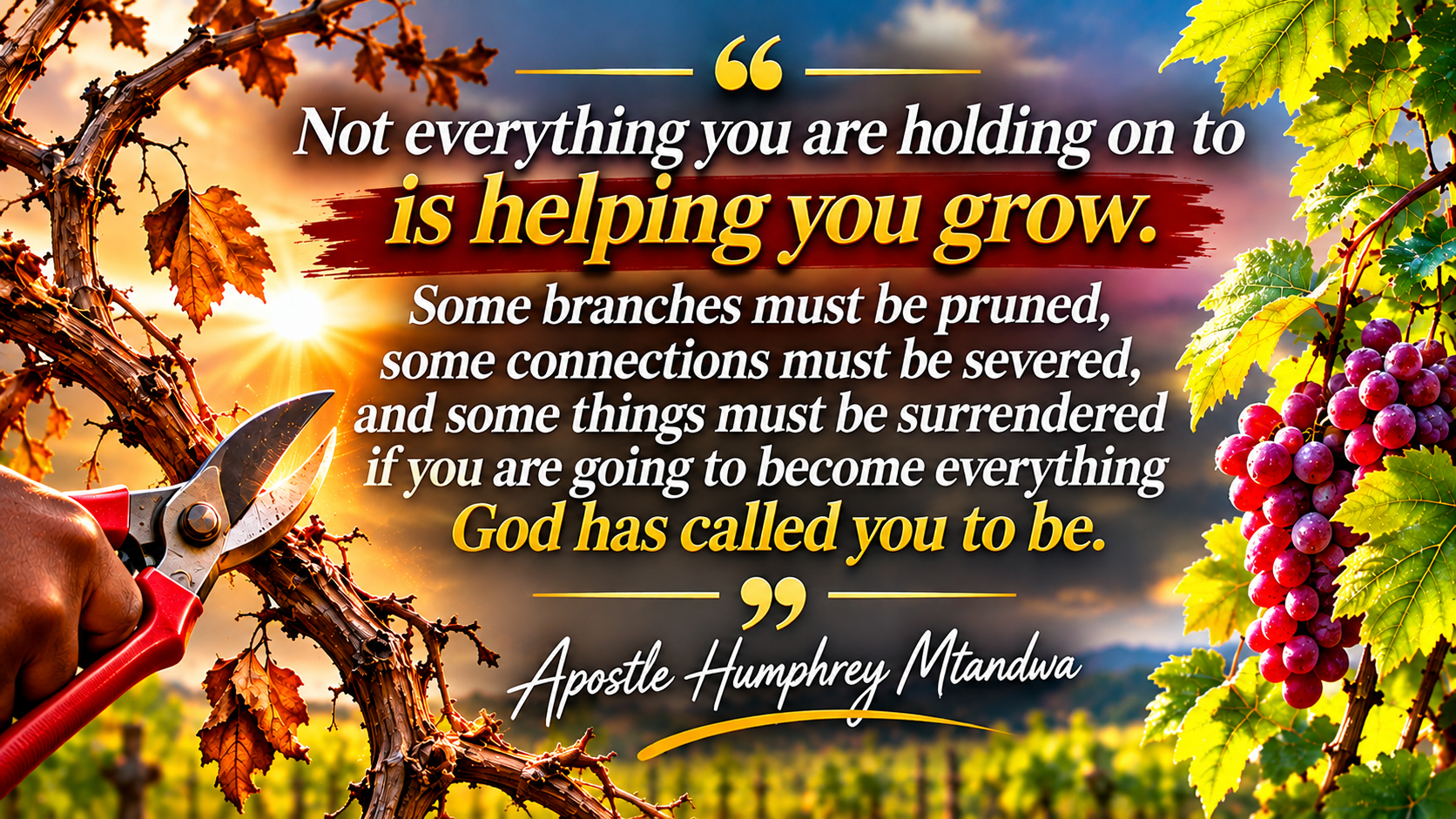
Not everything you are holding on to is helping you grow. Some branches must be pruned, some connections must be severed, and some things must be surrendered if you are going to become everything God has called you to be.
The Bible speaks in 2 Timothy 2:21 and says, “If a man therefore purge himself from these, he shall be a vessel unto honour, sanctified, and meet for the master's use, and prepared unto every good work.” There is something powerful about this scripture because it reveals that becoming a vessel of honour is not only about what God wants to multiply in your life; it is also about what He is willing to remove from your life. There is a double-sided aspect to purging: there are things God expects you to recognise and remove yourself, but there are also things He will have to remove when you are unwilling or unprepared to deal with them. Sometimes you must willingly cut off certain branches, and sometimes the Master Himself must intervene and prune you so that you can become more fruitful.
When a tree is growing, there are seasons when certain branches must be cut off. A tree cannot continue feeding every branch and still maintain the strength required to produce healthy fruit. Sometimes, it is not the big things that are preventing your growth; it is the small habits, familiar patterns and seemingly harmless attachments you have allowed to remain in your life. It could be an unproductive relationship that does not appear to be doing you any harm, but deep down, you know it is no longer contributing to where God is taking you. Some things are not necessarily destructive; they are simply unproductive. And sometimes, the fact that something is not hurting you does not mean it is helping you grow.
Interestingly, in John 15:2, Jesus introduces another dimension of this principle. He says, “Every branch in me that beareth fruit, he purgeth it, that it may bring forth more fruit.” Notice that the Lord does not only purge unproductive branches; He also prunes branches that are already bearing fruit. Pruning is not always about removing branches that are unproductive. Sometimes, the Master prunes branches that appear to be healthy and productive because He sees what they will become in the future. Imagine a business that is doing well today, generating income and appearing to be successful, yet the Lord knows that if you continue sustaining it, three years from now it could cost you not only your finances but even your spiritual well-being. This is why pruning requires us to trust the wisdom of the Master. Some things may look healthy in the present but carry the potential to restrict your fruitfulness in the future. It could be a relationship that appears healthy, a business that seems successful or even a ministry that looks like it is flourishing. Yet God sees beyond what you can see. He knows when something that is producing today will eventually drain your strength, compromise your purpose and limit the fruit you are supposed to bear tomorrow. Sometimes God removes what looks fruitful today to preserve the fruitfulness of your tomorrow.
There is, however, a difference between purging yourself and being purged by the Master. When you recognise that something is not contributing to your growth and willingly let it go, you are participating in your own pruning. You can walk away from an unhealthy relationship, abandon destructive habits, change your environment or disconnect from systems that are limiting your progress. But when you refuse to recognise what needs to be removed, circumstances may eventually force you to confront what you have been avoiding. The process can be much more painful because you have allowed something to remain long after its season has passed.
We see an interesting example in the early church. In Acts 1:8, Jesus instructed His disciples that they would receive power and become His witnesses in Jerusalem, Judea, Samaria and the uttermost parts of the earth. Yet, as we read the book of Acts, we discover that the church remained concentrated in Jerusalem for a season. Following the death of Stephen, persecution intensified, and Acts 8:1 tells us that believers were scattered throughout Judea and Samaria. What appeared to be a season of suffering became an instrument through which the gospel began spreading beyond Jerusalem. The death of James in Acts 12 further reveals the cost of the persecution that the early church experienced. Sometimes, what looks like disruption becomes the very instrument through which God advances His purpose.
How many people are unproductive today because they are holding on to branches that should have been removed years ago? Think about relationships that have lasted five, ten or even twelve years without producing anything healthy. People remain in environments where they are constantly diminished, discouraged and restricted. They become so accustomed to the dysfunction that they mistake familiarity for purpose. Yet, the moment they finally walk away, they begin discovering opportunities, peace and productivity they never realised were possible.
There are also things that God requires us to cut off internally. The children of Israel wandered in the wilderness, and one of the things that prevented an entire generation from entering the Promised Land was unbelief. Hebrews 3:19 tells us that they could not enter because of unbelief. They had to confront fear, rebellion and the unwillingness to trust God's promises. Some things do not need to be removed from your environment; they need to be removed from your heart.
One of the saddest but most powerful examples is the life of Moses. Moses was called to lead Israel into the Promised Land, but his struggle with anger eventually cost him the opportunity to enter it. In Numbers 20:10–12, when God instructed him to speak to the rock, Moses struck it instead. His disobedience had consequences, and God told him that he would not lead the congregation into the land. Imagine carrying a calling for so many years, enduring the wilderness, leading a nation, and then being unable to enter the promise because of a moment of disobedience. What could Moses have experienced if he had dealt with that area of his life?
Jesus also speaks about another dimension of pruning in John 15:2: “Every branch in me that beareth not fruit he taketh away.” There is a difference between pruning a fruitful branch and removing an unfruitful one. Sometimes a branch is pruned so that it can produce more fruit; at other times, it is removed because it is no longer contributing to the life of the vine. Romans 11:17–24 gives us another powerful picture through the illustration of branches being broken off and others being grafted into the olive tree. It reminds us that connection matters. You can have potential, but the environment or system you remain connected to may not be nourishing what God intends to produce through you.
The question, therefore, is not simply whether you have potential. The question is whether you are willing to remove whatever is preventing that potential from becoming productive. There are relationships you must reconsider, habits you must abandon, attitudes you must confront and environments you must leave. Some things you must cut off personally before circumstances force you to let them go.
It is easier to participate willingly in your pruning than to resist the process until something has to be removed. Remember, pruning is not necessarily rejection; sometimes it is preparation for greater fruitfulness.
My prayer for you is that you will have the wisdom to recognise what must be removed, the courage to let go of what is no longer productive, and the grace to embrace the pruning seasons of your life. May nothing you refuse to cut off become the reason you fail to step into what God has prepared for you. In Jesus' name. Amen.